

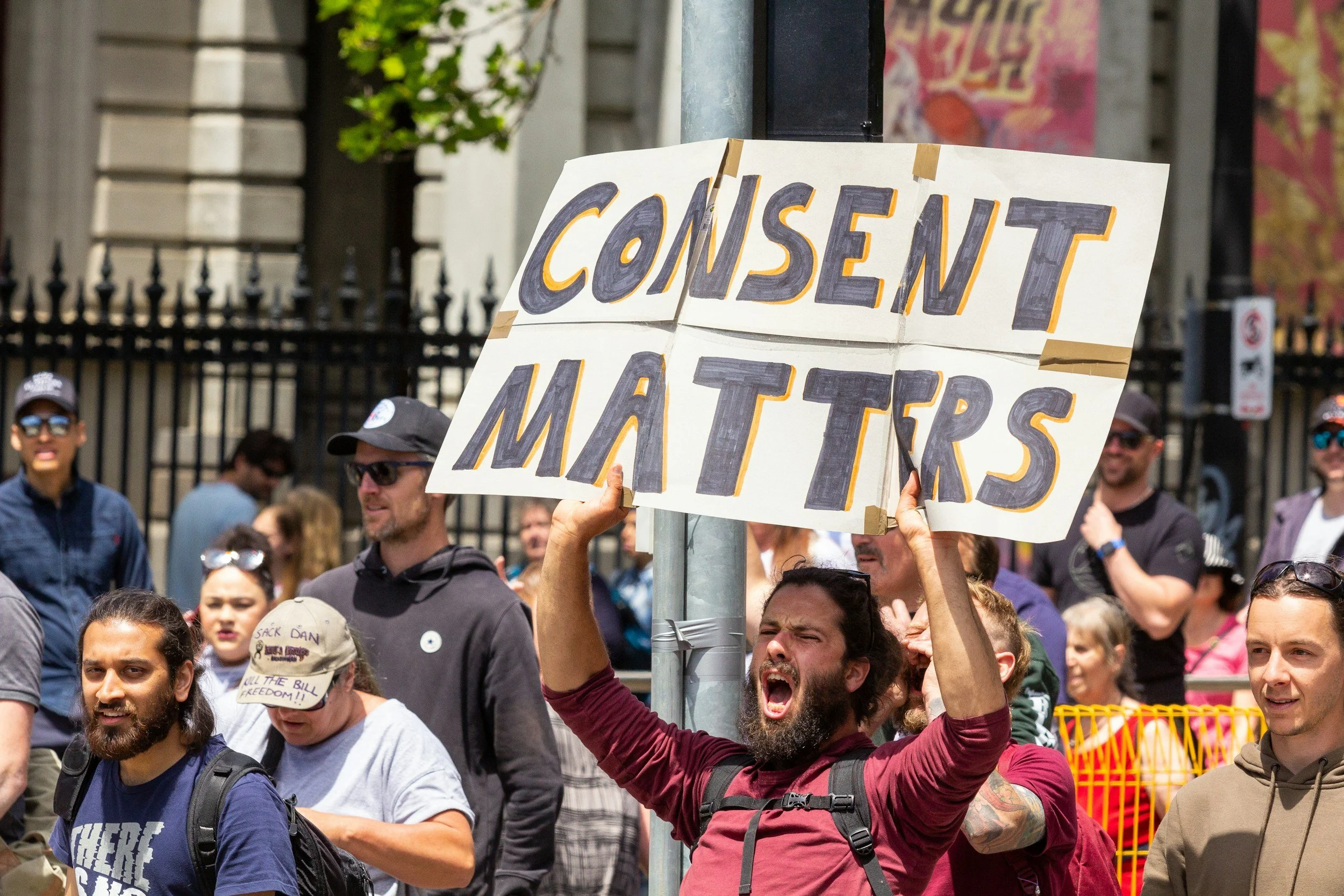
In this blog post we take a look at a recent paper, Reforming the Relationship between Sexual Consent, Deception and Mistake, created for the Criminal Law Reform Now Network (CLRNN). Launched in 2017, the mission of the Criminal Law Reform Now Network (CLRN Network) is “to facilitate collaboration between academics and other legal experts to gather and disseminate comprehensible proposals for criminal law reform to the wider community”. As such it is circulating in the right places, but has no legal teeth. However, this paper touches on many things we care deeply about, and perhaps we’ll send them this blog once completed. Maybe.
Meanwhile, that’s not a review of the paper. That’s below, but first we want to note a few things. This paper was reviewed with a view to looking only at consent and the effect of deception on consent, rather than as a whole. All points are drawn from the report itself.
Additionally, AI tools were used to summarise some of the text and cross referenced and amended as appropriate.
Why?
Here’s an example of some of the phrasing:
“i.e. ‘y’. If ‘y’ is a sexual act, we should charge D with a non-consensual sexual offence. Secondly, if V indicates that her consent to ‘y’ is conditional upon ‘x’ occurring prior to or simultaneously with ‘y’, and that condition is not met, then V does not consent to ‘y’. Again, if ‘y’ is a sexual act, we should charge D, the perpetrator of ‘y’, with a nonconsensual sexual offence.”
Using AI helped extract some key, salient points at a very busy time for us.
So, with no further ado, on with the show…..
How the Report Understands “Consent”: Consent as Sexual Autonomy, Not Mere Agreement
A core theme of the report is that sexual consent is grounded in sexual autonomy, not simply in “agreement”, wether verbal or behavioural .
The report emphasises that:
Consent is about choosing whether to engage in sexual activity on one’s own terms;
A person may appear to agree while lacking meaningful control over the decision;
Therefore, the law should care not only about whether consent was communicated, but how it was secured.
This framing is crucial to the report’s approach to deception.
The Problem with Current English Law on Deception and Consent: Narrow Statutory Vitiation of Consent
Under the Sexual Offences Act 2003, deception only vitiates consent in extremely limited circumstances (e.g. deception as to the nature or purpose of the act, or impersonation of a known person). This is not noted in the report, but the judgement in one of the’ Skycops’ cases effectively rendered laws on Rape by Deception nul and void, protections that are not currently covered under other laws.
The report repeatedly criticises current laws as:
Under-inclusive: Many serious deceptions leave consent legally intact
Conceptually incoherent:Small factual distinctions lead to large legal consequences
Misaligned with sexual autonomy
Courts have struggled to rationalise these limits, leading to oscillating and inconsistent case law (e.g. Assange, McNally, Lawrance).
Does Deception Negate Consent?
The report makes three nuanced claims:
Some deception does not affect consent at all
Some deception affects the quality of consent but does not eliminate it
Some deception so undermines autonomy that criminal liability is justified
This claims to avoid treating deception as legally irrelevant, but also avoids collapsing deception automatically into non-consent.
(We have some issues with this, and could foresee traumatised victims of grooming being expected to make complex arguments about the quality of their consent. Excuse us if we appear cynical about the justice system. We’ve seen the fallout!)
The Key Concept: Deception Inducing Consent: The Shift Away from “Vitiated Consent”
(Vitiated consent is consent that’s destroyed/damaged)
A central move in the report is to stop asking whether consent was “vitiated”, and instead ask “Was the complainant induced to engage in sexual activity by deception?”
This reframing matters because:
It accepts that consent may technically exist/have existed, but still be wrongfully obtained
It avoids distorting the concept of consent to do ‘moral’ work that cannot be clearly judged
It aligns with situations where the complainant did choose, but on fundamentally false premises
This approach puts pressure back onto proving that that concent was induced rather than permission destroyed. It would be useful inr cases of ‘catfishing’ where the deception is ‘textbook’ - false identity.
Factors that Make Deception Especially Significant for Consent
This report suggests that the factors making deception significant when discussing consent include:
Importance to the Deceived Person
Deception matters where the defendant knows that the truth would have led the other person not to agree. This puts the complainant’s actual decision-making front and centre rather than an abstract standard.
Purposeful Use of Deception
The report distinguishes between incidental deception, and deliberate deception used as a strategy to secure sex. We assume this to mean the mere puffs or boasts about sexual prowess and the like.
It is the intentional use of deception to obtain agreement that is treated as most autonomy-denying.
It would be interesting to see wether partners who lie about their marital status could fall into this category.
Connection to the Sexual Act
Rather than the rigid “nature vs circumstances” distinction in current law, the report treats relevance flexibly. What matters is whether the deception was instrumental in producing consent, not how it is categorised doctrinally.
This is the area were concern lies for us: in the ‘Spycops’ cases, for example, was their false identity enough to negate consent, or would it have to be something specific to the sexual act itself? If it’s the latter, this law is of little use to anyone groomed - it’s the deception that makes it harmful.
Consent vs Criminalisation
Why the report proposes a new offence rather than just expanding ‘non-consent’ :
The report explicitly rejects expanding when consent is deemed absent, arguing that doing so overburdens and distorts the concept of consent; that it risks making consent factually unrealistic (as no decision is ever fully informed); and that it blurs moral and legal distinctions that matter for fair labelling.
A New Offence?
Instead, the report recommends a new, standalone offence of “Inducing a person to engage in sexual activity by deception.”
This offence accepts that consent may exist, treats the deception as the wrongdoing, and focuses on the defendant’s awareness, purpose, and conduct rather than debates about consent.
Bottom-Line Conclusions on Consent and Deception
One of the report’s most important theoretical contributions is that consent is real and meaningful only when sexual autonomy is respected, but that deception can wrongfully secure consent without eliminating consent.
The CAAGe Perspective
We’re always open for discussion, but current law wrongly appears to treat most deceptive sex as legally consensual.
We define grooming as having two elements::
Intent
Consent
Someone’s intention may not be to cause harm – taking money from a sexual/romantic partner is not always intended fraud, for example. But if the victim wouldn’t have consented to parting with their money/had a relationship at all had they known that the sole intention of the friendship/relationship was to defraud, that’s grooming!
Under GDPR rules on consent regarding data use, in the UK we already have a definition of consent (ICO website version used):
“any freely given, specific, informed and unambiguous indication of the data subject’s wishes by which he or she, by a statement or by a clear affirmative action, signifies agreement (consent) …… to the processing of personal data relating to him or her”.
The elements of this are clear. Consent must be:
Freely given
Specific
Informed
Unambiguous
This definition is already in legal and regulatory use, and couldn’t be a lot clearer.
How is it that our email addresses and other data can have more protection under English Law than our bodies, hearts and emotional wellbeing?
Child, J. (Ed.) (2023). Reforming the Relationship between Sexual Consent, Deception and Mistake: CLRNN3 Report. Criminal Law Reform Now Network. http://www.clrnn.co.uk/media/1031/clrnn3-deception-report.pdf